How to Choose a Refrigeration Contractor: Reading Beyond the Proposal

Choosing a refrigeration contractor often starts with comparing proposals, schedules, and pricing. On paper, the process can appear straightforward. Contractors submit bids, scopes are reviewed, and decisions are made based on cost, timelines, and deliverables.
But a deeper evaluation and comparison of scope tell a more complicated story.
The real difference between contractors often becomes apparent during engineering coordination, fabrication, controls integration, installation, commissioning, and long-term system support. Small scope gaps or coordination issues during the estimating and scoping phase can later lead to rework, delays, rising costs, and operational inefficiencies, revealing that the initial comparison process did not capture the full reality of system delivery.
Most project issues are not caused by catastrophic failures, but by small coordination gaps that compound over time.
This pattern is not unique to refrigeration. Construction research has documented it extensively. McKinsey's research on large projects has repeatedly shown that major builds commonly run 20% longer than planned and exceed budgets by similar margins, driven primarily by coordination complexity rather than technical incompetence. Refrigeration systems simply concentrate these dynamics within a highly interdependent technical environment.
This article explores how to navigate bid comparisons and project scoping more effectively so you can make more informed refrigeration decisions. It explains how the contractor you choose ultimately determines how your facility behaves over the next 30 years.

Where Refrigeration Complexity Actually Resides
Industrial refrigeration systems are highly interdependent. Decisions made during one phase of the project often affect every phase and trade that follows.
Mechanical design choices influence building structural and fabrication requirements. Fabrication affects installation sequencing. Installation must align with roofing, fire protection, electrical infrastructure, and controls integration. Controls performance impacts commissioning, energy efficiency, and long-term operational reliability.
Because of this, even relatively small design or coordination changes can ripple through the project and create:
· Drawing revisions
· Installation conflicts
· Startup delays
· Change orders
· Rework
· Additional labor costs
Construction industry studies estimate that rework alone can consume between 5% and 15% of total project cost. On a refrigeration project valued at $8 million, that can represent hundreds of thousands or even millions of dollars in avoidable expense, from coordination mismatches, drawing ambiguities, sequencing conflicts, and scope interpretation gaps.
In many cases, these issues are not caused by poor workmanship. They result from unclear scope ownership, inconsistent coordination between disciplines, or gaps between engineering intent and field execution.
What Most Bid Comparisons Miss
Pricing variance between contractors is often read as a sign of efficiency or perceived as a better value. More often, it reflects differences in scope, structure, and risk distribution. Two proposals that look similar in cost may represent fundamentally different delivery systems. Innovative vertically integrates mechanical engineering, electrical engineering, controls, power distribution, fabrication, compliance, and commissioning within its own organizational boundary. Other contractors distribute portions of that responsibility across separate entities, thereby multiplying exposure to risk at each level.
Common areas of divergence include integration of mechanical and electrical engineering, responsibility for power distribution design, controls engineering and wiring scope, fabrication alignment with design intent, drawing updates including P&IDs, wiring diagram schematics, Management of Change, Sequence of Operations updates, updates to engineering calculations, commissioning depth and methodology, and lifecycle service infrastructure. With Innovative, these solutions are handled in-house by our specialized engineering team, ensuring that the original intent of the design is fulfilled while maintaining competitive pricing.
Vertical Integration as a Reduction of Variables
Vertical integration is often described operationally. Its more consequential impact is structural: the reduction of coordination variables within inherently complex systems. By aligning mechanical and electrical engineering, permit drawings, fabrication drawings, manufacturing, installation, power distribution, controls wiring, commissioning, compliance services, and lifecycle support within a unified organizational framework, a more seamless approach with less variability is achieved.
Accountability boundaries sharpen. Resolution velocity increases not because projects become simpler, but because independent and external coordination variables are reduced. Explore how Innovative's design-build services put this model into practice daily.

Lifecycle Economics and Compounding Effects
Installation costs occupy a brief window. Operational performance persists for decades. Even marginal inefficiencies compound into substantial lifecycle expense. A system that consumes 7% more energy annually generates measurable long-term cost exposure. Controls instability increases maintenance frequency. Maintenance frequency elevates downtime probability. Downtime probability carries production consequences.
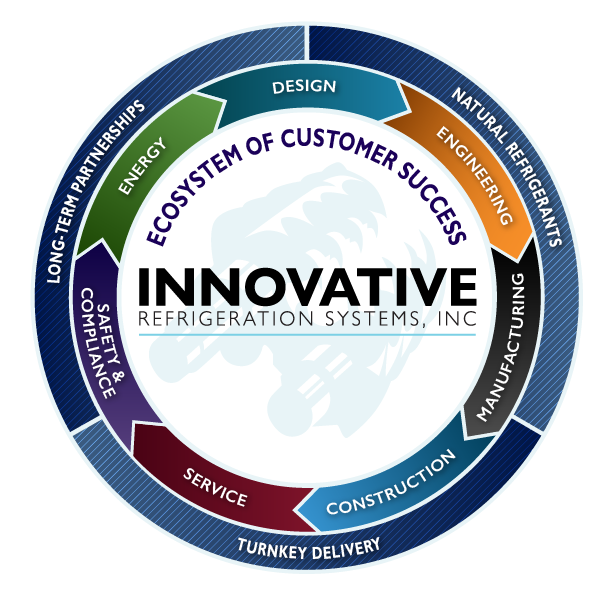
Innovative’s holistic approach to design ensures that your facility will have the lowest operational costs year over year. When engaged in our ecosystem of success, facilities on average see 11% lower electrical bills than competing facilities. This tremendous savings is a result of internal synergies between departments working towards customer success. This success starts at the design engineering phase of the project and carries through the entire process of the project: manufacturing, construction, commissioning, service, compliance and Innovative's SiteSense energy management platform.
Our team doesn’t walk away when the project is complete, we partner with you for life.
System Architecture through Contractor Selection
Understanding how to choose a refrigeration contractor means recognizing that every selection functions as an act of system architecture. Every decision embeds a coordination structure governing how complexity, variability, accountability, and risk behave throughout the life of the system. Over more than 30 years of pioneering natural refrigeration solutions, Innovative has developed an execution architecture designed to contain variability by compressing interfaces. This includes 12 in-house professional engineers integrating mechanical, electrical, and controls design; 430,000-plus square feet of dedicated manufacturing capacity; 350-plus skilled tradesmen deployed nationwide; proven delivery across 300-plus ammonia facilities; deep expertise spanning 100-plus CO2 systems; and a demonstrated history of bid accuracy with cost variance well below 1%.
Training through the Industrial Refrigeration Technical College (IRTC) further embeds system intelligence within operator ecosystems, reinforcing stability through knowledge architecture rather than reactive troubleshooting. Explore Innovative's full history and capabilities.
Bottom Line
Choosing a refrigeration contractor is not merely an evaluation of a proposal. It is an evaluation of the system architecture embedded within that proposal — a choice about how the system itself will behave over time. What is truly being compared? Is it price, or variability exposure? Is it scope, or coordination architecture? Is it capability, or interface density? Is it installation cost, or lifecycle behavior?
Proposals describe what can be documented: equipment, deliverables, timelines, and financial structures. What they cannot fully express are the behavioral properties that govern execution stability, how decisions propagate between disciplines, how variability is absorbed, and how predictability is engineered into the system from the start. Those are the true differentiators that drive project success. Our team is here to support you through the selection process to ensure that your project is scoped correctly and that you receive a competitive price for a world class, energy efficient refrigeration system.
Ready to Discuss Your Next Project?
Contact us today to speak with an engineering expert about your ammonia or CO₂ refrigeration system. Reach out to Innovative's team here.