What Does Thermal-First Data Center Design Mean for Cooling Plants?
AI is changing the order of data center design. In the air-cooling era, racks drew roughly 3 to 6 kW of power. Now, hyperscalers are installing racks that reach 100 kW and beyond, and the frontier of rack development is pushing towards 1 MW racks. At today's rack densities, thermal strategy has to come first.
That approach is called thermal-first design, and it changes how data centers are engineered from start to finish. Thermal-first design determines how heat leaves the building, how the plant handles sudden load swings, and how the facility will adapt when the next generation of chips arrives. In addition to future-ready design, a thermal-first strategy can foster new approaches to maximizing energy efficiency.
In case you missed it: See our earlier post on the benefits of natural refrigerants for data centers.
What Does "Thermal-First" Mean?
A thermal-first data center design means the heat-removal strategy is determined at the start of the project, and the rest of the facility is engineered around it. Traditional projects ran in sequence: design the building, secure the power, then figure out the cooling strategy. At rack densities above 100 kW, that sequence leaves too little room for growth and rack upgrades.
In practice, a thermal-first approach finds answers to several important engineering questions:
- How much heat must the facility reject at full build-out?
- What supply temperatures will the IT equipment accept?
- How will power, controls, and cooling share redundancy and failure modes?
- How much does the site's climate and water supply limit heat-rejection options?
Density also isn't uniform across the industry. Uptime Institute's 2026 Global Data Center Survey reports a most common rack density of 11 kW, so AI-scale racks are the leading edge, not the average. Facilities that mix densities need a cooling strategy that can serve both ends of the spectrum.
Warm-Water DLC Lowers Water Use, But Heat Rejection Is Still Needed
Warm-water liquid cooling reduces how much mechanical cooling a data center needs, but it does not eliminate heat rejection. Even in a liquid-cooled rack today, liquid handles about 70 to 80% of the cooling requirement, and air-cooled equipment still handles the other 20 to 30%.
Supply temperature matters most. When the liquid loop can run at 45°C or higher, dry coolers can reject heat to the air for much of the year in many climates, and chillers run less. How much less depends on three site factors:
- Peak ambient conditions: the hottest design days set the capacity the plant must still deliver
- Water availability: this decides whether evaporative assist is an option
- The residual air-side load: equipment that isn't liquid-cooled still needs cooler fluid than the warm loop provides
The takeaway for design: size the plant for the hottest hours and the residual air load, not only the average year. That is where a right-sized mechanical cooling layer earns its place, and where the engineering and system design work upfront pays off.
Designing for the Life of the Facility
A data center is built to operate for 15 to 25 years, while chip power and cooling needs can change much faster. Equipment makers are already discussing racks of 1 MW, up from today's 100 kW. Engineering flexibility for future upgrades and increasing power loads is essential.
A flexible plant is designed to cover a range, not a single point:
- A range of supply temperatures: the plant works whether the loop runs warm or cooler as hardware changes
- Modular capacity: chillers, pumps, and heat rejection are added in stages as the load ramps
- Hybrid heat rejection: free cooling when the weather allows, mechanical cooling when it doesn't
The mechanical cooling layer of that hybrid plant is where natural refrigerants fit. Ammonia (R717) has a global warming potential of zero and excellent heat-transfer properties for large loads.
Refrigerant supply is the other long-term factor. The AIM Act directs EPA to phase down HFC production and consumption by 85% by 2036. The EPA’s Final HFC Rule outlines the allowance cap for HFCs, falling from 60% of baseline in 2024 through 2028 to 30% in 2029 through 2033, 20% in 2034 and 2035, and 15% from 2036. A plant designed for a 15-to-25-year life should assume the HFC supply it relies on keeps tightening.
The market is moving too. Industry analysts expect global data center capacity to nearly double from 103 GW to 200 GW by 2030. Natural refrigerants will be a growing part of the equation for meeting that demand.
Liquid Cooling Runs Like Process Cooling
At 100 kW per rack and above, liquid cooling stops behaving like comfort cooling. It is a process system: flows, temperatures, and pressures have to be held tightly, and disturbances have to be caught fast. That is familiar territory for industrial refrigeration.
Stable control, careful commissioning, and mechanical integrity are core practices for ammonia systems, and they carry over directly to a data center cooling plant. Innovative's open-protocol refrigeration controls are built for that kind of stability.
Safety is a priority at every system size. How much regulation applies depends on how much ammonia is in a process. At 10,000 pounds or more of anhydrous ammonia in a process, OSHA's Process Safety Management standard (29 CFR 1910.119) applies. It brings 14 program elements, including process hazard analysis, mechanical integrity, management of change, and emergency planning. Below that threshold, a system still needs to adhere to the EPA’s General Duty Clause, along with sound design, regular training, and maintenance.
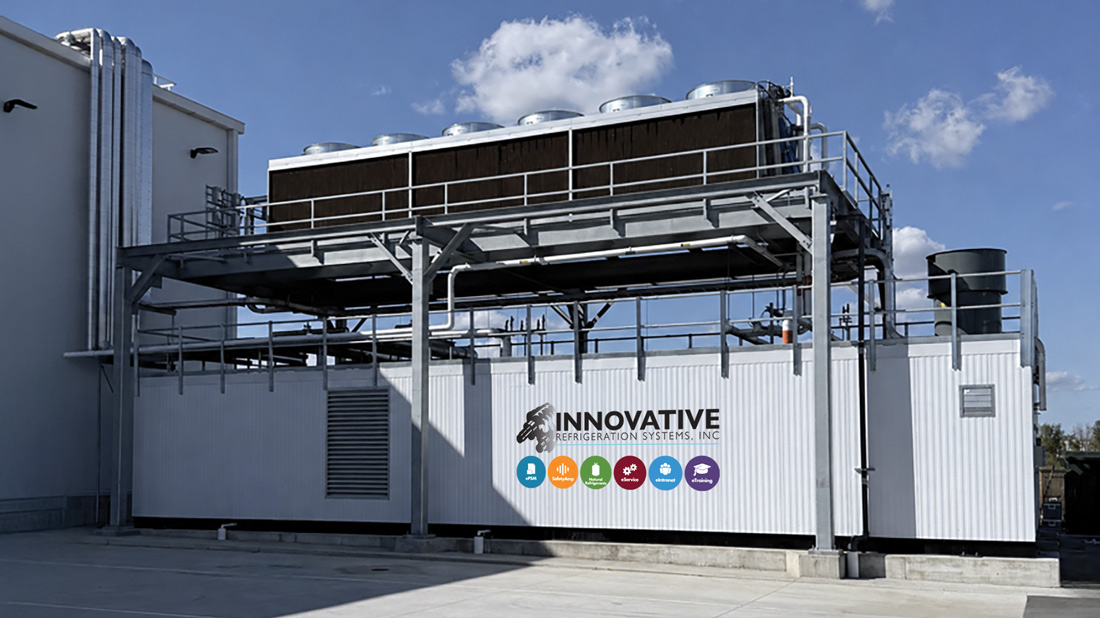
Design choices affect where a system lands relative to that line. Packaged chillers with a secondary water or glycol loop keep the ammonia in a dedicated mechanical area, separated from the data hall, and can keep the charge compact. Innovative's engineers evaluate the charge case by case, and our Process Safety Management team supports compliance when a system is covered.
Thermal-First Starts with Engineering a Cooling Strategy
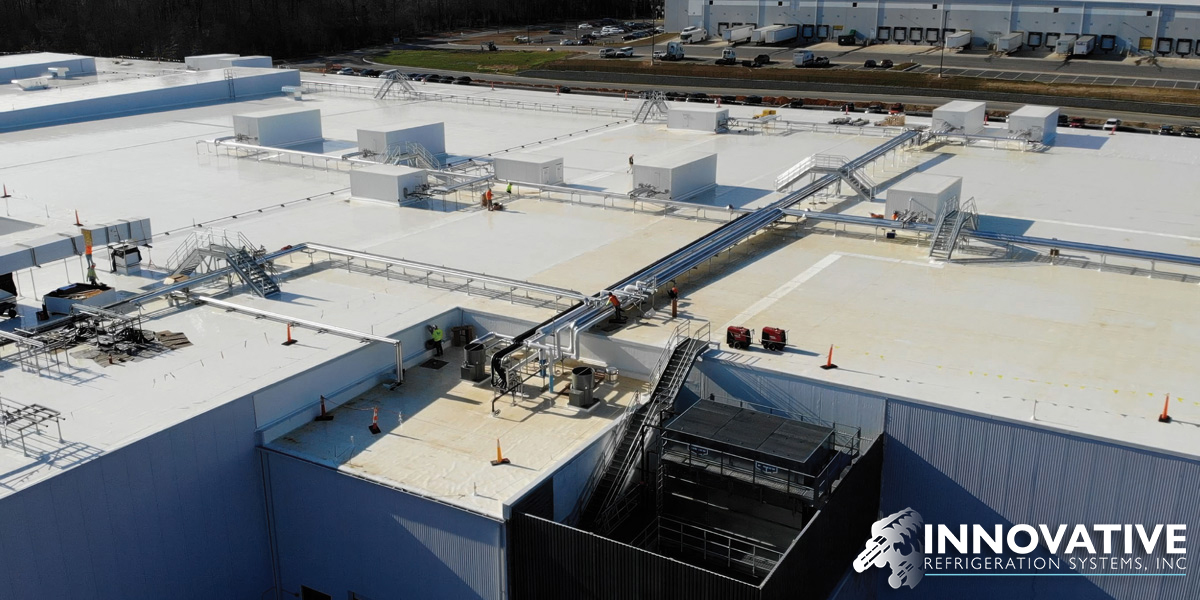
Thermal-first design treats the cooling plant as a core part of the facility rather than an afterthought. For most AI data centers, that means warm-water liquid cooling at the rack, a hybrid heat-rejection system sized for peak days and the residual air load, a design that holds up across a range of temperatures, and controls and safety practices built for a process system.
Natural refrigerant chillers fit as the mechanical layer of that plant, with low GWP, strong performance at large loads, and a refrigerant path that doesn't depend on heavily regulated HFCs.
Innovative Refrigeration Systems brings more than 30 years of industrial refrigeration experience to the data center market, with expertise in natural refrigerant systems, from excellent in engineering to manufacturing and turnkey installation.
Planning an adaptable data center cooling strategy? Talk with Innovative Refrigeration Systems about your project.

