Why Are Data Centers Turning to Natural Refrigerants to Solve Their Heat Challenge?

AI and high-performance computing are creating a new challenge for data center operators: how to capture, transport, and ultimately reject increasing heat loads. As projects become more complex, operators are exploring innovative cooling strategies designed around their specific thermal, operational, and infrastructure requirements. Natural refrigeration systems can be part of an effective, efficient, and future-proof solution.
Why Natural Refrigerants?
Ammonia (R717) has been used for decades in demanding industrial refrigeration applications where dependable, continuous cooling is critical. R717 has excellent heat-transfer and thermodynamic properties, making this refrigerant ideally suited for large thermal loads. Additionally, ammonia has a very low global warming potential compared with synthetic refrigerants.
High-density computing environments require cooling systems that can maintain stable conditions continuously, respond to fluctuating thermal loads, and support redundancy strategies designed to protect critical infrastructure. Refrigeration systems engineered around natural refrigerants like ammonia can provide reliable, efficient cooling performance while supporting the flexibility and long-term operating requirements of data centers.
This makes natural refrigerants an increasingly relevant option for data center cooling, particularly when they are incorporated into a system designed around the facility's specific thermal load, operating temperatures, redundancy requirements, and future growth.
Applying Industrial Refrigeration Expertise to Data Centers
For Innovative Refrigeration Systems, designing systems around demanding thermal loads is not new. Large-scale refrigeration and process cooling have been the company’s focus for more than 30 years.
Industrial refrigeration systems routinely have to remove large amounts of heat, respond to changing loads, and operate reliably in facilities where downtime is not an option. Those same system-level demands are becoming increasingly relevant to data centers.
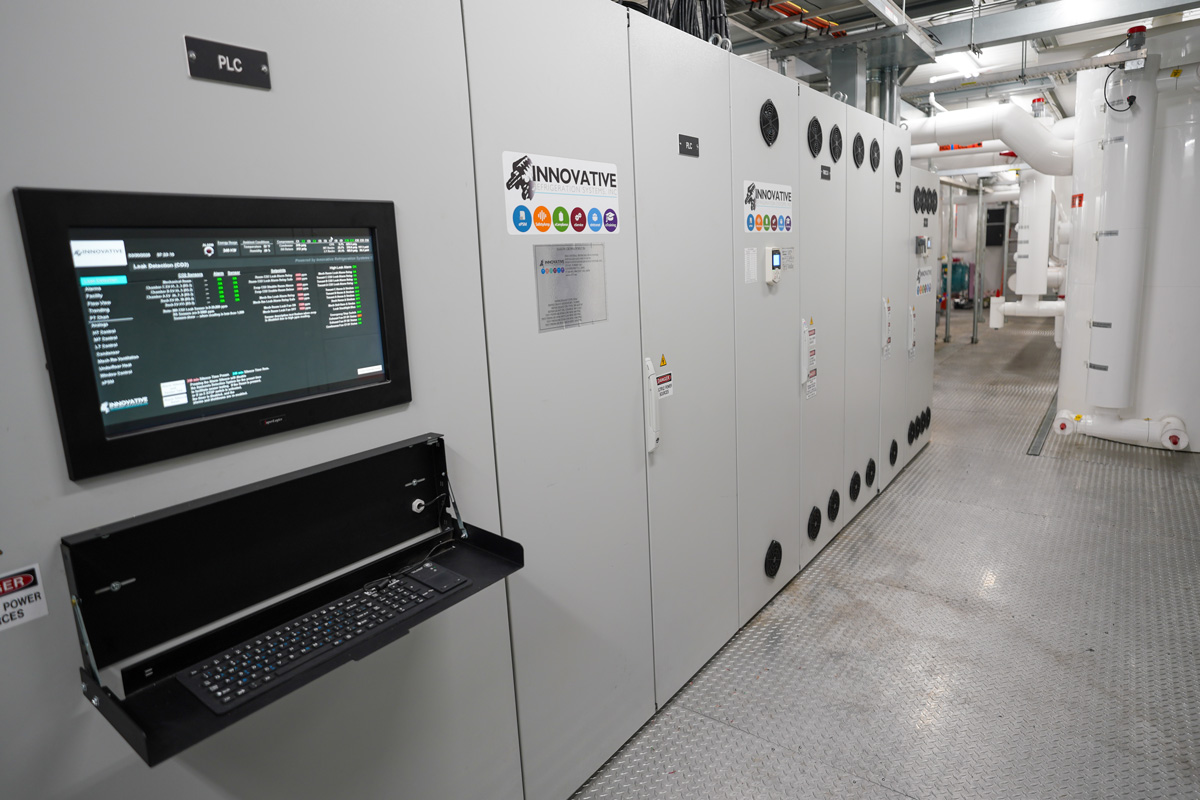
An ammonia cooling system can be designed so the refrigerant remains within a dedicated mechanical area or packaged chiller, while a secondary water or glycol loop circulates cooling throughout the facility. This approach allows the refrigeration system to handle large-scale heat transfer while separating the primary refrigerant from the data hall. The refrigeration engineers at Innovative Refrigeration Systems will design the best solution for your specific application.
The result is a cooling architecture that can combine natural-refrigerant technology with the liquid-cooling infrastructure required by today's high-density computing environments.
Future-Proofing Thermal Management
Choosing a refrigerant is only one part of the design process. Thermal load, operating temperatures, climate, water availability, heat rejection, redundancy, and future growth all influence how a data center cooling system should be configured.
For some facilities, minimizing water consumption may be the priority. For others, energy efficiency, redundancy, or the ability to expand cooling capacity overtime may carry greater weight. The right solution depends on the application.
A future-ready cooling strategy should account for these variables from the beginning. As computing densities increase and cooling requirements evolve, systems designed with flexibility and scalability in mind can make it easier to adapt capacity, operating conditions, and heat-rejection strategies without fundamentally reworking the facility's infrastructure.
A Natural Fit for the Next Generation of Data Centers
As computing density continues to rise, data centers will require innovative cooling solutions that encompass refrigeration, liquid cooling, heat rejection, controls, and facility infrastructure functioning together as one system.
Natural refrigerants like ammonia offer an efficient, low-GWP solution. Combined with the right system architecture, turnkey ammonia systems provide data center operators with a cost-effective tool for addressing the growing thermal demands of high-performance computing.
With the stakes rising, proven outcomes and experience matter. Innovative Refrigeration Systems brings more than 30 years of industrial refrigeration experience to the data center market, with expertise in ammonia-based natural refrigerant systems, process safety management, open-protocol controls, and manufacturing.
Looking for a cooling strategy built around the demands of your data center? Talk with Innovative Refrigeration Systems about your next project.