The 14 Elements of Process Safety Management: A Guide for Industrial Refrigeration Operators

Process Safety Management (PSM) is OSHA's framework for preventing catastrophic chemical releases, and for ammonia refrigeration it breaks down into 14 elements that your facility must put into practice.
Congress set this in motion with the Clean Air Act Amendments of 1990, which directed OSHA to set requirements for managing highly hazardous substances. The goal: prevent and mitigate catastrophic releases of flammable, explosive, reactive, and toxic chemicals that may endanger workers. OSHA issued the resulting standard, 29 CFR 1910.119, in 1992. It covers the manufacture of explosives and processes involving threshold quantities of flammable liquids and gases (10,000 lbs), as well as 137 listed highly hazardous chemicals.
For industrial refrigeration operators, the listed chemical that comes to mind is anhydrous ammonia. R-1234 refrigerants (commonly known as HFOs) also fall under the PSM standard. If a process holds 10,000 lbs or more of these refrigerants, PSM applies.
PSM is also a performance-based standard. Unlike OSHA rules that prescribe exactly what to do, it outlines the key features of a safety program and leaves you the flexibility to tailor it to your facility. That flexibility is useful, but it means you have to define what "adequate" looks like for your system, and be able to show it. Here is what each element asks of you.
PSM Elements 1–5: Building the Foundation
The first five elements set up the knowledge, analysis, and people your program depends on.
1. Employee Participation
You need a written plan for how employee stake part in your PSM program. That includes consulting employees and their representatives on process hazard analyses and other PSM elements, and giving them access to PHAs and the other information the standard requires.
2. Process Safety Information (PSI)
PSI is the documented description of what you are operating. It covers the hazards of the chemical, the technology of the process (including process flow diagrams or P&IDs and safe operating limits), and the equipment (including materials of construction, relief system design, and the codes and standards used).
3. Process Hazard Analysis (PHA)
A PHA is a systematic review of what could go wrong, how likely it is, and what protects you. A team with engineering and operating expertise performs it. It must address the process hazards, past incidents, facility siting, human factors, and the team's recommendations have to be resolved and documented promptly. The PHA must be updated and revalidated at least every five years.
4. Operating Procedures
You need written, clear instructions foreach phase of operation: initial startup, normal operations, temporary operations, emergency shutdown, emergency operations, normal shutdown, and startup after a turnaround or emergency shutdown. Procedures also cover operating limits and the consequences of deviating from them. They must be accessible to the people who use them, reviewed as often as necessary, and certified annually as current and accurate.
5. Training
Employees operating the process need initial training on the process overview, operating procedures, emergency operations, and safe work practices before they are assigned to it. Refresher training is required at least every three years. You must document that each employee was trained and understood the material.
Elements 6–9: Keeping the System Safe Day-to-Day
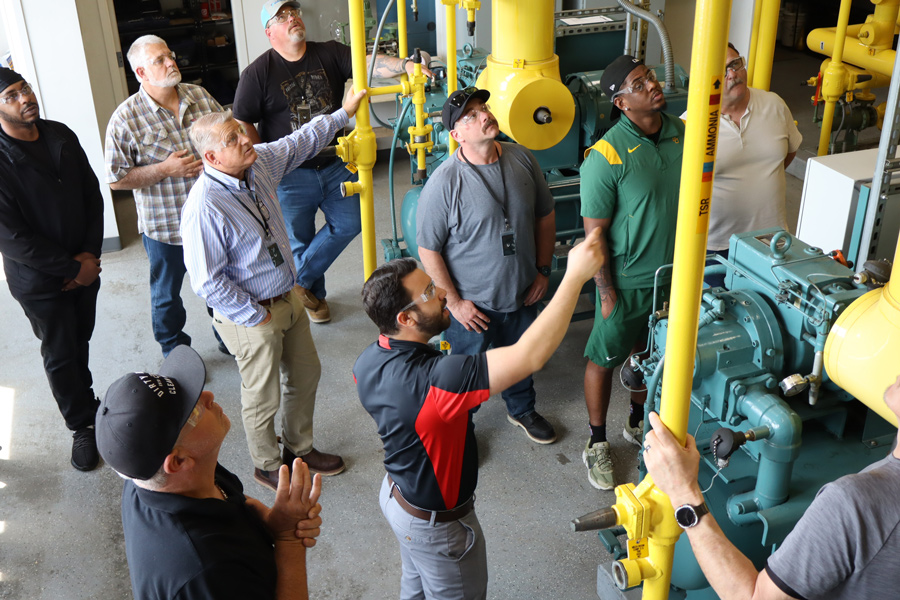
These four elements govern who works on your system, how it is started up, and how it is kept in good condition.
6. Contractors
This element applies to contractors doing maintenance, repair, turnaround, renovation, or specialty work on or adjacent to a covered process. As the host employer, you must consider contractors' safety performance and programs when selecting them, inform them of the process hazards and your emergency action plan, and periodically evaluate how they are performing. Contract employers have their own duties: training their people, documenting it, and making sure they follow your safety rules. Welders, mechanical contractors, electricians and insulation crews working around ammonia piping all fall under this.
7. Pre-Startup Safety Review (PSSR)
Before ammonia goes into a new system, or into a modified one where the change requires updates to your process safety information, a PSSR confirms that you are ready. It verifies that construction and equipment match the design specifications, that safety, operating, maintenance, and emergency procedures are in place and adequate, that the PHA was done for new systems and its recommendations resolved. A PSSR also verifies that training is complete.
8. Mechanical Integrity (MI)
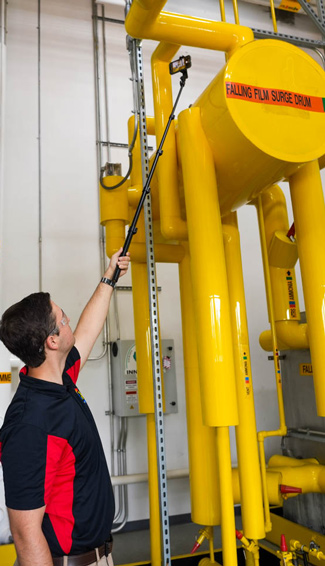
Mechanical integrity keeps the equipment that contains and controls ammonia fit for service. It covers pressure vessels, piping systems and their components, relief and vent systems, emergency shutdown systems, controls (including sensors, alarms, and interlocks), and pumps. Most ammonia programs also include compressors, condensers, and evaporators.
You need written procedures, trained personnel, and inspection and testing that follows recognized and generally accepted good engineering practices, documented each time. Deficiencies must be corrected before further use or in a safe and timely manner.
For operators, this is typically where most of the day-to-day PSM effort goes, and it is where well-maintained controls and sensors earn their keep.
Here's why Innovative's engineers recommend ultrasonic testing for MI.
9. Hot Work Permit
Any hot work on or near a covered process needs a permit. The permit documents that fire prevention and protection requirements have been implemented, shows the dates authorized and the object of the work, and stays on file until the work is complete.
PSM Elements 10–14: Managing Change, Learning, and Accountability
The last five elements keep the program alive as your system, your people, and your risks change.
10. Management of Change (MOC)
Any change to chemicals, technology, equipment, procedures, or facilities that affects a covered process, other than a replacement in kind, goes through a written MOC procedure. Before the change, you document the technical basis, the impact on safety and health, needed changes to operating procedures, the time period for the change, and who authorizes it.
11. Incident Investigation
You must investigate every incident that resulted in, or could reasonably have resulted in, a catastrophic release. That includes near misses. The investigation must begin within 48 hours, use a team that includes someone knowledgeable about the process, and end with a written report covering what happened, the contributing factors, and recommendations. Findings must be addressed promptly, reviewed with affected personnel, and kept on file for five years.
12. Emergency Planning and Response
You need an emergency action plan, and you must decide whether employees will respond to a release or evacuate. If your people respond, the OSHA emergency response provisions, including HAZWOPER training, apply. Whichever route you choose, the plan should be specific to your facility and practiced, not just written.
13. Compliance Audits
At least every three years, you must certify that you have evaluated compliance with PSM, verifying that your procedures and practices are adequate and being followed. A person knowledgeable about the process must conduct the audit, a report of findings is prepared, and you must promptly determine and document how each deficiency is addressed. The two most recent audit reports must be kept.
Innovative's team of engineers can complete compliance audits for you. Here's how it works.
14. Trade Secrets
This element ensures that confidentiality never blocks safety. You must make all the information needed to comply with PSM available to the people compiling PSI, conducting PHAs, writing operating procedures, investigating incidents, planning for emergencies, and performing audits, regardless of trade secret status. You may require those people to sign confidentiality agreements.
Making the 14 Elements Work Together
Each of the 14 elements of PSM depends on the others. Your PSI makes a meaningful PHA possible, the PHA shapes your procedures and mechanical integrity priorities, and MOC keeps everything current as the system changes. Incident investigations and compliance audits then feed their findings back into the PHA. When one element slips, others tend to follow.
To stay on top of it, assign an owner to each element, know where its records live, and track when its next review is due. Or, have Innovative’s engineers take care of PSM for you.
Innovative Refrigeration Systems is a full-service industrial refrigeration company, from design-build ammonia and CO2 systems to PSM, controls, and service, supporting customers across a range of industries. We’re built by people who take ownership of their work and pride in the solutions they deliver. Reach out to our team to talk through how your system and program line up with these elements.